


StrategyNovember 8, 2026 · 9 min read
Teen Residential Treatment Marketing for Parent Research
Ethan Sweet
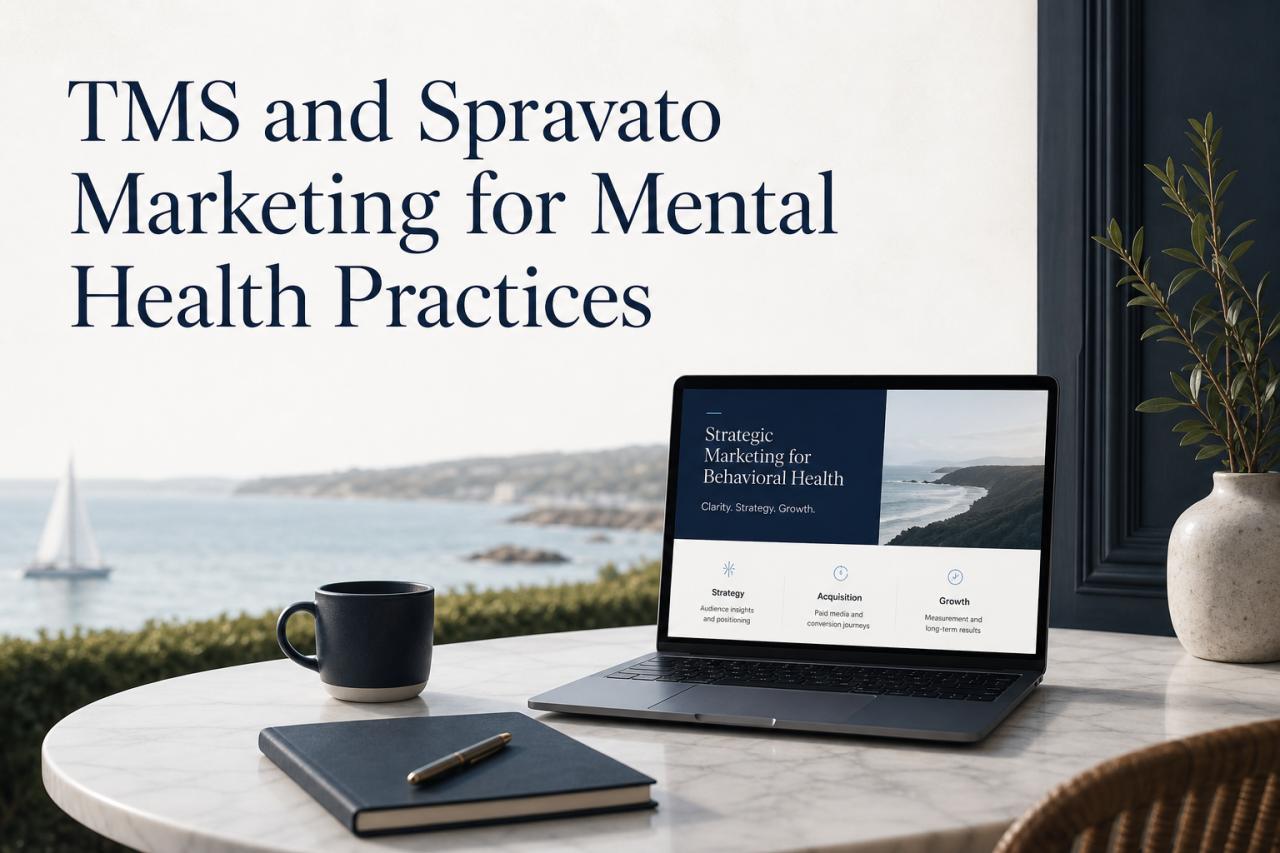
TMS marketing works when you target treatment-resistant depression searches and referring prescribers. Learn keywords, claim limits, and metrics to track.
Most people who end up in a chair for transcranial magnetic stimulation never typed "TMS" into Google. They searched for why their antidepressants stopped working, and TMS marketing succeeds when your practice shows up for that search. Sweet Media builds service pages and paid campaigns for mental health programs, and this is the framework we use for interventional psychiatry.
Patients usually arrive knowing their diagnosis and how much time they've lost to treatment, not how the technology works. Your pages have to meet them there.
Multi-chair psychiatry and outpatient mental health operators can compare full-funnel scopes on our mental health marketing agency page.
Someone who has tried two or three medications is searching in the language of failure: "antidepressants not working," "depression that won't go away," "what to do when medication doesn't help." Those phrases are the entry point. Treatment-resistant depression is the intent category your pages should own.
The keywords that tend to produce qualified consultation requests combine that condition language with a next step. Think of searches about options after failed medication, nonmedication depression treatment, and evaluation for treatment-resistant depression. Branded terms like TMS therapy or Spravato esketamine matter too, but they come from people who are already educated, and there are fewer of them.
Build one page per intent rather than one page for everything. A treatment-resistant depression page explains the problem and introduces both options. Separate TMS treatment and Spravato pages then answer the specific questions that follow.
The FDA first approved TMS in 2008 for major depressive disorder, according to the American Psychiatric Association. Your copy should name only the indications your devices are actually cleared for, and it should not imply clearance for bipolar disorder.
Brain stimulation language needs the same restraint. You can explain that a magnetic coil delivers pulses to targeted brain circuits, and that TMS is generally done as an outpatient procedure with no anesthesia or sedation, so patients can drive to and from appointments, per the APA. You can't promise a result or a timeline.
Plain side effects messaging helps you here. Scalp discomfort and headache are commonly discussed, and UT Southwestern describes seizure as the one known medical risk, at under 1% of patients. Say both. Prescribers tend to read balanced copy as a sign of a clinically serious practice.
Time is the objection patients raise most. A standard course involves five treatments per week for four to six weeks, according to the APA, which is hard for anyone with a job or children. Accelerated TMS compresses sessions into a shorter window. One NAMI patient account describes treatment over five consecutive days with several short sessions each day, and that's a real scheduling differentiator.
Protocols vary by clinic, so describe your own schedule rather than the category. State how many sessions per day, how long each visit runs, and how many weeks the course takes. Don't claim an accelerated protocol works faster or better unless your clinical team can support it.
Spravato (esketamine) is FDA approved and dispensed only through a REMS program at certified sites. Janssen controls brand name usage, and there are limits on how providers describe it. Check your certification status and the manufacturer's guidance before publishing any page or ad. Effective Spravato marketing and Spravato marketing services explain REMS certification, the two-hour observation window, and commercial prior authorization in plain language, while social media marketing services for TMS therapy educate prospective patients on daily session schedules.
The audience differs as well. TMS is a medication-free procedure that patients can often hear about as an alternative. Spravato is a monitored in-clinic medication, so the message centers on supervised visits and logistics, and the page shouldn't read like a promotional pitch.
Imagine a primary care physician with a patient who has cycled through three medications and is out of ideas. That doctor refers to the practice that made the next step easy to understand, not the one with the loudest ad. For many practices, referring prescribers are the real front door.
Prescribers want a short list of things before they send anyone. They want your clinical criteria, the evaluation process, and what happens to the patient's medication plan. They also want to know how you communicate back, because most will keep managing medication while the patient completes treatment.
Position TMS as one part of a care pathway, alongside medication and therapy, rather than a replacement. Build a referral page and a one-page summary that covers screening for contraindications and a psychiatric evaluation as the gateway step. Mention a validated intake tool like the PHQ-9 only if your clinicians actually use it.
RELATED READING
Clinical eligibility and payer coverage are separate questions, and your copy should keep them separate. Eligibility is the clinician's judgment about whether the treatment fits. Coverage is the payer's criteria, and the APA notes that many carriers cover standard TMS after three to four prior antidepressant trials without response.
Coverage varies by plan, so never write as if it's uniform. Explain that your team verifies benefits and handles prior authorization, list what documentation typically helps, and offer a verification form. When payer rules change, update the page the same week, because stale coverage language generates unqualified leads and frustrated calls.
Address cost and time openly too. A patient writing for NAMI called accelerated TMS expensive, with widely varying coverage and a significant time commitment, and your page should answer those questions before a caller has to ask.
Sweet Media is a behavioral health digital marketing agency in Costa Mesa, California, and we build the pieces above as admissions infrastructure. That means treatment-resistant depression service pages, TMS and Spravato pages written within claim limits, and referral materials for prescribers. Our mental health SEO guide covers the organic side in more depth.
On the paid side, our paid media work is built around consultation requests, not clicks. Google Ads for treatment-resistant depression searches can be worth running once your landing pages and intake process are ready. Without them, you pay for traffic that can't convert.
Track consultation requests, not sessions or impressions. The numbers that tell you something are verification-ready inquiries, evaluations booked, evaluations completed, and patients who start a course. Add referral source tracking so you can see which prescribers send patients who actually begin.
Call quality matters as much as call volume. Listen to recordings and tag whether the caller has a depression history, has tried medication, and has coverage questions you can answer. Then compare keyword themes against those tags to see which searches produce evaluations.
Avoid implying approval beyond the cleared or approved indications, and avoid speed or outcome guarantees. Off-label language needs particular care, so have your clinical lead and counsel review it. Google and Meta also apply their own healthcare advertising policies, which change, so check current rules before launching campaigns.
Yes, once the landing page, benefit verification, and intake are ready. Start with condition-based searches, keep copy within cleared indications, and judge results by evaluations booked.
Explain the process in plain terms and say that coverage varies by plan. Offer a verification form and avoid promising approval.
They want clear clinical criteria, your evaluation and screening process, and a plan for communicating back. They also want to know the patient stays under their medication management if appropriate.
Only carefully. The FDA's 2008 approval was for major depressive disorder, so don't imply clearance for bipolar disorder, and let your clinical team decide how to describe screening for it.
If you want a second set of eyes on your TMS and Spravato pages, request a free media audit or book a free strategy call with Sweet Media. We'll review where treatment-resistant depression searches and prescriber referrals are leaking out of your funnel.
About the author

Ethan founded Sweet Media to give behavioral health facilities an agency that speaks the language of treatment — and measures success in admissions, not impressions.
CONNECT ON LINKEDINIn this article
Tags
CONTINUE READING
StrategyNovember 8, 2026 · 9 min read

StrategyNovember 3, 2026 · 9 min read

StrategyNovember 2, 2026 · 13 min read
StrategyOctober 30, 2026 · 11 min read

StrategyOctober 29, 2026 · 10 min read

StrategyOctober 28, 2026 · 10 min read
MORE FROM STRATEGY
VIEW ALLMental health facility playbook
We build diagnosis-level search pages, compliant Google Ads, and fast benefit verification for residential and outpatient mental health facilities.